
Print


03 12 2025 13:23
News Code : 162023571
View Count : 1177
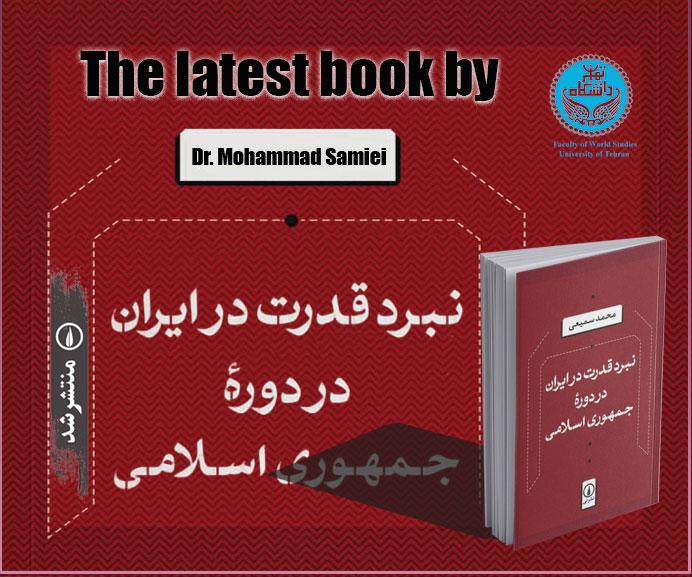
The latest book by Dr. Mohammad Samiei, faculty member of the Faculty of World Studies, University of Tehran, titled “The Power Struggle in Iran during the Islamic Republic”, has been published by Ney Publishing.
According to the author, the Islamic Republic of Iran has faced four major challenges since its inception—and continues to do so today:
An inherent theoretical inconsistency;
A non-conventional position within the international system;
A long list of adversaries;
And a performance record that is not impressive compared to peer countries.
Because of these factors, from the early days of the revolution many believed the Islamic Republic would not survive its sixth month, first year, second year, or even its tenth year—and, according to predictions by John Bolton, a prominent neoconservative figure in various U.S. administrations, would not reach its fortieth anniversary.
Yet despite all these challenges, the Islamic Republic has endured. This raises a central question: how and why has the system managed to withstand these problems and persist? In other words, what is the secret of its durability?
In addition to addressing this core question, the book examines in its various chapters the internal and external factors that weaken the system, as well as the major challenges and “mega-challenges” it faces.
(Excerpted from the book’s introduction)
This volume is a continuation of the author’s earlier work, “The Power Struggle in Iran: Why and How Did the Clergy Win?”, and seeks to analyze the evolution of power structures in the Islamic Republic over more than four decades—years marked by events such as the hostage crisis, sanctions, the “maximum pressure” campaign, and nuclear negotiations, all of which have contributed to a constantly shifting political landscape.
Dr. Samiei’s new book is organized into 10 chapters plus a concluding section, extending across 596 pages, and explores the roles of political, economic, religious, and security institutions in shaping and sustaining Iran’s power structure. While grounded in historical analysis, the book aims to provide a systematic understanding of the actors and forces driving developments inside Iran.
Table of Contents:
The Clergy in Search of a Utopia
The Decline of Intellectualism
Government and Factional Competition
Money and Power
The Military Forces and Intelligence Institutions
From Shadow Imperialism to “Death to the Great Satan”
The Counter-Revolution
The Masses
An Analysis of the Durability of the Islamic Republic and the Mega-Challenges Ahead
Conclusion, Notes, Bibliography, and Index
https://fws.ut.ac.ir/ru/article/162023571